
Games System Overview
The Games section on Saga Slots is not just a catalogue of titles placed under one navigation label. It is a structured mix of very different play models, each built around its own pacing logic, interaction depth, and relationship to randomness. That difference matters because a player does not move from Roulette to Blackjack, or from Bingo to Aviator, inside the same behavioural system. The stake may look similar on the surface, and every format still ends in a measurable outcome, but the path between those two points changes from one category to another. A product-led Games page should make that clear from the start rather than presenting all game types as if they belonged to a single undifferentiated entertainment block.
On Saga Slots, the Games section includes Roulette, Blackjack, Poker, Bingo, Live casino, and Aviator. These categories sit side by side, but they do not create the same session texture. Roulette is built around round-based independent outcomes where the player selects exposure before the wheel resolves the event. Blackjack introduces a decision layer inside the hand, which means the session is shaped not only by card distribution but also by player input during play. Poker shifts even further toward structured decision-making, because the experience depends on comparative positioning, betting logic, and table flow rather than on a single isolated event. Bingo, by contrast, is lighter in interaction and is usually read more as a paced number-cycle format than as an intensity-driven decision product. Live casino changes the environment again by placing familiar rules into a streamed real-time setting, where tempo is no longer instant and where the session feels more social, visual, and operational. Aviator sits apart from all of them because it compresses the entire experience into a rising multiplier event where timing becomes the central interaction point.
The most useful way to understand this page is to stop thinking in terms of “which game is better” and instead read each category as a different model of player involvement. Some formats are outcome-first, where the player mostly chooses a position and then waits for resolution. Others are decision-assisted, where the player meaningfully participates once the round is already active. Others are tempo-led, where the key difference is not the mathematical core but the rhythm at which events appear and resolve. This shift in perspective makes the page more useful because it replaces vague promotional language with structural clarity. A fast automated round, a streamed live round, and a timing-based crash cycle may all be entertaining in different ways, but they should not be explained through the same vocabulary.
Randomness remains central across the full Games section, but it appears through different interfaces. In Roulette, the wheel result is independent from previous rounds. In Blackjack, card distribution remains random even though the player makes choices inside the hand. In Poker, randomness exists in card dealing, yet the session also depends heavily on comparative decisions and table behaviour. In Bingo, the draw sequence defines the pace of the session more than any individual tactical action. In Live casino, the real-time environment changes the feel of the game without changing the underlying rule structure of the format being played. In Aviator, the multiplier path defines the cycle, but the interaction is built around timing the exit rather than around selecting symbols, numbers, or card actions. Because of this, the Games page should never imply that one category offers inherently stronger results than another. The real distinction is in rhythm, control, and how the user experiences each round.
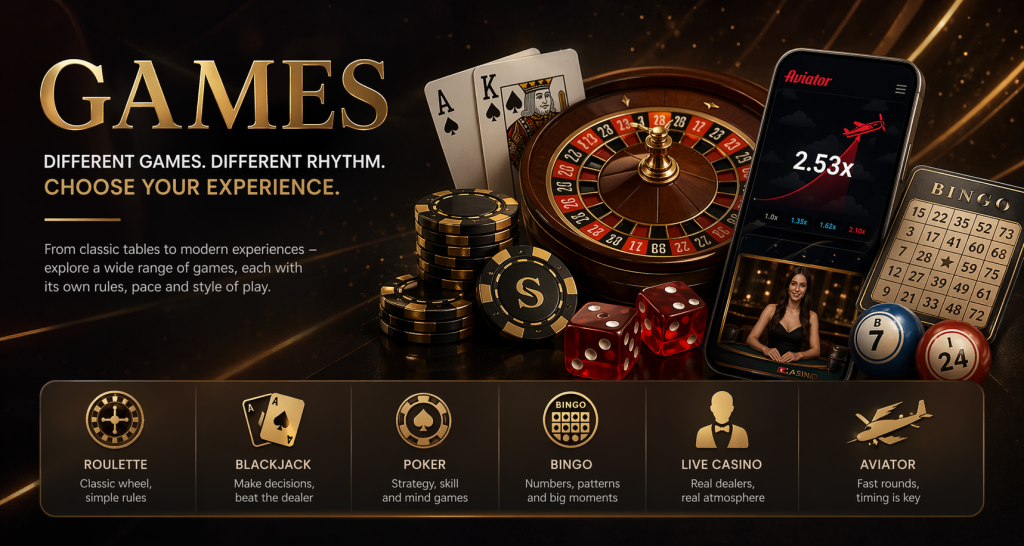
This is exactly why category clarity matters on an operator-level platform. A player coming to the Games page should be able to recognise, within a few seconds, whether a format is passive or active, slow or compressed, automated or decision-led, visually continuous or structurally concentrated. That kind of clarity supports trust because it treats the catalogue as a product system rather than as a sales wall. It also improves navigation. Someone looking for round-based simplicity will read Roulette differently from someone looking for real-time interaction in Live casino. A user who wants faster compressed cycles may move naturally toward Aviator, while another who prefers a more measured table structure may stay with Blackjack or Poker. The page works best when it helps the player understand those differences before the session begins.
The six categories on this page therefore need to be read as separate operational formats: Roulette as a wheel-based independent outcome system, Blackjack as a card game with embedded decision points, Poker as a table strategy format with comparative logic, Bingo as a paced draw-based experience, Live casino as a real-time streamed extension of classic formats, and Aviator as a timing-led crash model built around a single rising event curve. Once that structure is clear, the catalogue stops looking random and starts looking organised. That is the right foundation for the rest of the page, because the next step is to map these categories visually and analytically rather than describe them in generic casino language.
Game Interaction Model
This table compares how each game type operates in terms of pacing, player input, and randomness. It is a structural view, not a performance ranking.
| Game | Interaction Model | Session Pace | Analytical Note |
|---|---|---|---|
| Roulette | Outcome-first | Round-based | Player selects exposure before the event. Outcome is independent each round. |
| Blackjack | Decision-assisted | Moderate | Player decisions influence the path, but randomness remains in card distribution. |
| Poker | Strategic | Variable | Session shaped by player behaviour and table dynamics, not single outcomes. |
| Bingo | Passive cycle | Slow-paced | Number draw defines rhythm. Minimal player input during active cycle. |
| Live casino | Real-time | Human-paced | Same rules as table games, but pacing follows live dealer flow. |
| Aviator | Timing-based | Fast | Outcome curve is predefined. Player interaction is based on exit timing. |
Session Rhythm, Decision Depth, and Game Behaviour
Once the Games catalogue is understood as a group of different interaction models, the next useful layer is how those models behave across time inside a real session. This is where many casino pages become too generic, because they describe all games through the same language of excitement, speed, or reward. In practice, Roulette, Blackjack, Poker, Bingo, Live casino, and Aviator do not create the same type of user experience even when they sit under the same navigation label. The difference is not simply visual. It sits in the rhythm of each round, the amount of attention the player must give to the active state of the game, and the extent to which the player is acting inside the round rather than only before it begins.
A round-based game such as Roulette asks the player to define position first and then wait for an independent result. Blackjack changes that structure by inserting meaningful decisions into the middle of the hand. Poker goes further, because the session becomes more layered and comparative, with the player reacting not only to cards but also to table flow, betting patterns, and relative positioning. Bingo remains more passive and draw-driven, where the pace of the cycle matters more than in-round control. Live casino shifts familiar rules into a real-time streamed environment, which reduces the sense of automation and increases the importance of tempo, presentation, and human pacing. Aviator compresses the model again into a much shorter cycle where the key interaction is timing an exit rather than managing cards, numbers, or long decision trees.
This is why the Games page needs a behavioural graph rather than only descriptive text. The user should be able to see, at a glance, how these formats move from lower decision density toward higher decision density, and from slower session rhythm toward faster compressed cycles. That kind of visual model does not claim that one game is better than another. It simply clarifies how each format behaves. A player looking for calmer, round-led play will read Bingo differently from Blackjack. A player who wants quick repetition and compressed tension will read Aviator differently from Live casino. The value of the graph is that it turns those differences into something operational and visible, without slipping into hype language or implying that pacing has any effect on outcome quality.
Game Rhythm and Decision Density
These bands show how the games catalogue moves from lighter round-following formats toward faster or more decision-dense structures. This is an interaction model, not a payout or performance model.
The graph above helps translate the catalogue into a behavioural model rather than a marketing layout. Instead of reading the Games page through labels alone, the user can see how each format sits in relation to round speed, decision pressure, and interaction density. That makes the catalogue easier to navigate because it turns game choice into a question of preferred structure rather than imagined advantage. A player who wants more time between actions will not read Aviator in the same way as Bingo. A player who wants higher involvement inside the round will not experience Roulette in the same way as Blackjack or Poker. The point is not to rank them, but to make their logic visible enough that the user can recognise the right category before entering play.
Account Layer, Bonus Interaction, and Game Choice
By this stage the Games page has separated formats by structure, pacing, and interaction. The final layer is how those formats behave once they are used inside an account that may include active promotional conditions. This is where confusion usually appears, because players tend to merge the behaviour of the game with the behaviour of the account. In practice, those are two different systems operating at the same time. The game produces outcomes according to its own rules and randomness model. The account layer processes those outcomes under the conditions that are currently active, which may include bonus-linked restrictions, wagering requirements, or release thresholds.
It is important to keep this separation clear. A game does not become more favourable because a bonus is active. Roulette does not change its wheel distribution, Blackjack does not alter its card logic, and Aviator does not adjust its multiplier curve based on account status. What changes is how the resulting value is handled once it reaches the wallet. Some balances may remain restricted until wagering is completed. Some actions may contribute to eligible volume while others do not. The experience can feel different from the user perspective, but the underlying game remains the same. That is why an operator-level page explains bonus interaction as an account process, not as a gameplay enhancement.
Another useful way to read this layer is to focus on contribution logic rather than activity. Not every game contributes to wagering in the same way under every promotion. Some formats may be fully eligible, others partially eligible, and some may not contribute at all depending on the terms in place. From the user side, this can create a gap between visible activity and actual progress. A session may feel busy and active, but the account may still be in a restricted state if the required conditions are not being met. This is not a malfunction. It is the expected behaviour of a system that separates game output from wallet processing.
The table below translates this into a structured view. It shows how each game format is typically read at the account layer when bonus conditions are active. It does not rank games or suggest which one should be used. It simply clarifies how interaction, contribution, and processing logic tend to align.
Game Formats and Account Processing
This table explains how different game types are typically interpreted at the account layer when bonus conditions are active. It focuses on processing logic, not outcomes.
| Game | Account Layer Reading | Contribution Profile | Analytical Note |
|---|---|---|---|
| Roulette | Round-based exposure may contribute depending on promotion rules. | Conditional | Simple structure makes it easy to track, but contribution depends on active terms. |
| Blackjack | Decision-based play may have limited or adjusted contribution rates. | Restricted | Player input does not override contribution rules defined by the system. |
| Poker | Often treated differently due to multi-player and strategic structure. | Limited | Session logic is not aligned with standard wagering measurement. |
| Bingo | Draw-based participation may not align strongly with wagering models. | Low | Activity is visible, but contribution can be minimal under many systems. |
| Live casino | Real-time table formats may follow separate contribution rules. | Variable | Same mechanics as tables, but processed differently at the account layer. |
| Aviator | Fast cycle gameplay may or may not count depending on conditions. | Conditional | High activity does not automatically mean faster wagering progress. |
A useful addition here is that game choice should be treated as a structural preference before it is treated as a bonus-related decision. Saga Slots can make this clearer by showing category labels, interaction depth, session tempo, and contribution status as separate pieces of information. This helps users understand whether they are choosing Roulette, Blackjack, Poker, Bingo, Live casino, or Aviator because of the way the format behaves, or because a specific account rule currently applies to it.
This separation also supports more accurate account reading. A fast game may create frequent activity without producing faster bonus progress, while a slower game may still be more understandable for users who prefer clearer round structure. When the Games page keeps gameplay logic and wallet processing visible as separate layers, players can compare formats more calmly: randomness defines outcomes, interaction model shapes the session, and account rules determine how value is processed after the result appears.