
Slot System Structure
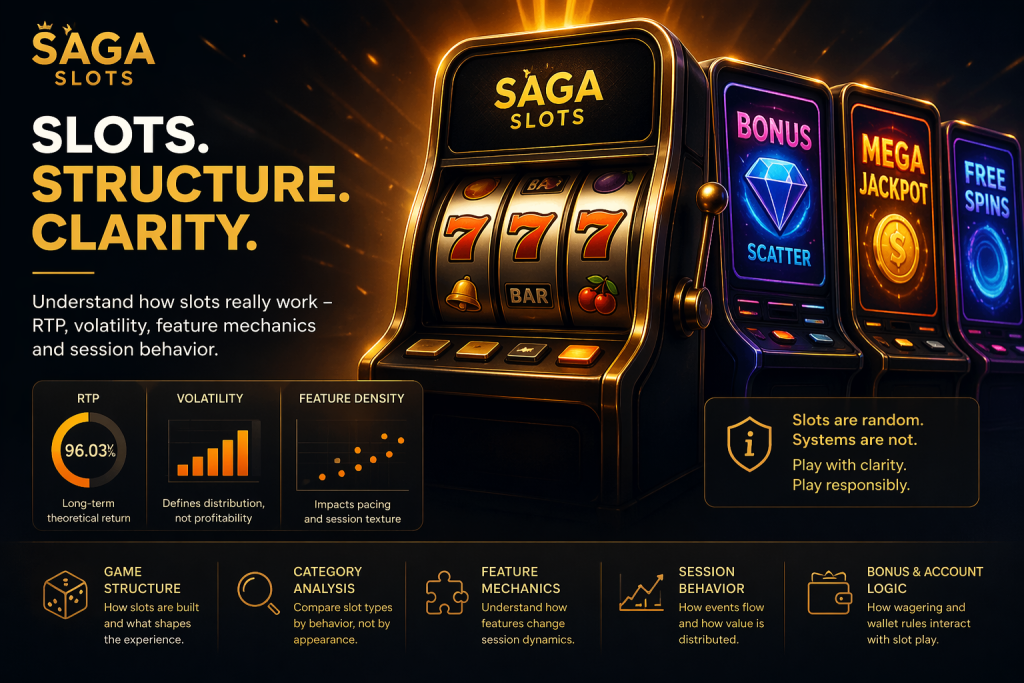
Slots on Saga Slots are not built as “games that react to players.”
They are structured as deterministic systems driven by probabilistic output, where the visual layer exists to represent outcomes that are already defined before the spin animation even begins.
When a player presses spin, nothing is being “decided” at that moment in a cinematic sense. The outcome has already been generated by the internal engine. What the player sees — the reels, the motion, the delay — is a presentation sequence, not a calculation phase. This distinction matters, because it removes the idea that timing, rhythm, or player behaviour can influence results.
RNG: Outcome Engine
At the core sits a Random Number Generator — not as a feature, but as the fundamental system that defines every result. It operates independently of user input beyond the initial trigger. Once the spin is initiated, the system produces a number sequence that maps to a predefined outcome in the slot’s logic.
There is no persistence between spins. The system does not store “recent results” to adjust future ones. It does not track losses or wins in a way that would influence probability. Each spin is a closed event.
This means a sequence of 20 losing spins does not increase the likelihood of a win on the 21st. It also means that a large win does not “reset” the system or reduce the probability of another win. The generator is memoryless, and this property defines the entire gameplay structure.
RTP: Long-Term Distribution Model
Return to Player is often presented as a percentage, but in operational terms it is a distribution model rather than a promise or guarantee. It defines how value circulates through the system over a very large number of iterations.
In short sessions, RTP is effectively invisible. A player can experience outcomes that appear far above or far below the stated percentage, simply because the sample size is too small to reflect the model. The variance dominates the experience at low spin counts.
Only when the number of spins becomes statistically meaningful does the distribution begin to resemble the theoretical RTP. This is why RTP should be read as a structural property of the game, not as a short-term expectation.
Volatility: How Outcomes Are Distributed
Volatility shapes the experience more than RTP in most real sessions. It defines how often outcomes occur and how those outcomes are distributed in size.
In low volatility slots, the system returns value frequently, but in smaller increments. The session tends to feel stable, with regular activity and fewer long gaps between events. In high volatility slots, the opposite is true — extended sequences of neutral or low-value spins are common, followed by infrequent but larger events.
Two slots can share the same RTP and still feel completely different because volatility determines pacing, not overall return. It influences how the session unfolds, not the long-term mathematics behind it.
The Spin as a Process, Not a Moment
A spin is often perceived as a single action, but internally it is part of a multi-step process. The RNG generates an outcome, which is then translated into symbols through the game engine. That symbolic representation is rendered visually, after which feature logic may activate depending on the outcome. Only after all of this does the system apply the result to the wallet.
What the player experiences as a “spin” is therefore a chain of transformations. Understanding this helps separate perception from structure. The reels do not decide outcomes — they display them.
Demo Mode: Understanding Without Outcome Pressure
Demo mode exists as a way to observe the system without financial input, but it should not be interpreted as a predictive environment. The same logic applies, but the absence of real value removes the behavioural pressure that often shapes how players interpret results.
It is useful for understanding how features trigger, how often events occur, and how a slot behaves over time in terms of pacing. However, it does not provide insight into future outcomes in real sessions. The randomness remains unchanged.
This structure defines everything that follows.
Slot categories, bonus interaction, and session experience all sit on top of this foundation.
Slot Volatility and Session Texture
These bands show how different slot formats usually distribute event frequency, feature spacing, and value concentration across a session. This is a behaviour-reading model, not a payout promise or performance indicator.
Slot Categories and Reading the Catalogue
A slot page should not read like a wall of titles. On a product-led platform, the slot catalogue needs to help the player understand what kind of session a game is likely to create before any money is committed. That does not mean predicting outcomes, because outcomes remain random and independent, but it does mean describing structure in a useful way. A classic reel slot, a feature-dense video slot, and a high-volatility bonus-heavy title may all sit under the same “slots” label, yet the practical experience they create is very different. One may produce frequent low-intensity feedback, another may rely on occasional modifiers and layered symbols, while a third may remain visually quiet for long stretches before concentrating most of its theoretical value into fewer events.
This is where category reading becomes more valuable than headline marketing. Instead of asking whether a slot is “good,” the better question is what sort of pacing it produces, how feature-dependent it is, and how its volatility profile changes the feel of a session. For Saga Slots, that means presenting the slot library as a set of behavioural formats rather than as a list of promises. Some players want flatter rhythm and more visible continuity. Others are comfortable with wider gaps between events if the structure is built around stronger feature concentration. Neither approach is inherently better. They simply create different session textures, and the job of the page is to make those differences legible.
Another useful distinction is between visible activity and meaningful activity. A slot can keep the screen busy without materially changing the structure of the session. Frequent micro-events, animated symbols, or recurring reel effects may make the game feel active, but that does not automatically mean the volatility is low or that the player is moving toward any stable result. In the same way, a quieter slot can feel slower while still concentrating more of its design logic into feature triggers, multipliers, respins, or bonus rounds. Reading slots properly means looking past the surface animation and identifying how the game distributes outcomes across time. That is why a structured table works better here than a generic promotional block. It lets the page classify slot behaviour in a way that is useful on both desktop and mobile.
Below is the premium category table for the Slots page. It follows the same dark analytical language and search-led interaction logic, but it is mapped specifically to slot behaviour, pacing, and volatility reading.
Slot Category Mapping and Session Reading
This table groups common slot formats by pacing, volatility profile, and feature density. It is designed to help users read the structure of the catalogue rather than assume that all slots create the same session texture.
| Slot Category ↕ | Play Rhythm ↕ | Volatility Profile ↕ | Analytical Note |
|---|---|---|---|
| Classic reel slot | Steady visual rhythm with lighter feature layering. |
Lower variance | Usually easier to read structurally because the session relies less on stacked mechanics and more on repeatable reel cadence. |
| Modern video slot | Balanced pacing with moderate event spacing. |
Medium variance | Often the broadest category on a slot page because it can combine familiar pacing with accessible feature logic. |
| Feature-heavy slot | More dependent on triggered mechanics and event clusters. |
Medium-high variance | The experience is shaped less by base-spin continuity and more by how frequently enhanced mechanics enter the cycle. |
| Bonus-heavy slot | Longer neutral stretches interrupted by less frequent feature events. |
High variance | Most of the game’s perceived intensity often sits inside the bonus cycle rather than the base game itself. |
| Cascading slot | Reactive sequences that can extend a single event chain. |
Variable distribution | These titles often feel more animated because one resolved spin may still produce several stages of visual continuation. |
| Dynamic-ways slot | Changing reel structure creates less uniform pacing across spins. |
Upper-mid variance | The changing layout increases perceived movement, but the key analytical question remains how value is distributed over time. |
| Jackpot-linked slot | Often sparse and heavily concentrated around rare value states. |
Very high variance | Jackpot association changes perceived scale, but it does not change the independence of spins or the need to read volatility carefully. |
| Light-session slot | Softer pacing with easier surface readability. |
Low-mid variance | Useful for users who want the catalogue to feel clearer and less compressed by stacked mechanics or long inactive spans. |
This kind of classification matters because it moves the Slots page away from generic promotional language and toward product clarity. A user does not need to be told that every slot is exciting. What helps more is knowing whether a title is likely to feel compressed or open, whether most of its weight sits in the base game or in triggered rounds, and whether its volatility profile suggests flatter continuity or wider spacing between meaningful events. That is a better reading model for an operator-led page, because it gives the player a framework without pretending to control outcomes. It also makes the catalogue easier to navigate on mobile, where users often scan rather than read linearly, and need structural clues quickly.
Feature Density, Event Flow, and Session Texture
Once slot categories are understood at a surface level, the next layer is how those categories behave over time inside a session. Not in terms of outcomes, but in terms of event flow — how often something happens, what kind of events those are, and how they are spaced.
Two slots can belong to the same category and still feel very different because of feature density. One might rely heavily on base-game repetition with occasional modifiers, while another compresses most of its structural weight into bonus triggers, respins, or multiplier phases. The difference is not in RTP, and not in “chance,” but in how the experience is distributed across time.
A useful way to read this is to separate visual continuity from structural activity.
A slot can:
- look active (animations, symbols, motion)
- but remain structurally quiet (low-impact outcomes)
Or:
- look slower
- but carry more structural weight inside fewer, more concentrated events
This is why players often misread sessions. They respond to motion and feedback rather than to how the system actually distributes value.
Event Flow vs Feature Concentration
Slots generally sit somewhere between two poles:
- Event-dense systems
Frequent small interactions, more visible continuity, less reliance on single large triggers - Feature-concentrated systems
Longer neutral cycles, fewer but more structurally important feature events
Neither model is better. They simply shape how a session unfolds.
Saga Slots does not prioritise one over the other. Instead, the catalogue includes both, and the purpose of this page is to make that distinction visible before a player enters the game.
Why This Matters in Practice
Understanding feature density changes how a player interprets a session:
- In a dense system, inactivity feels unusual
- In a concentrated system, inactivity is part of the structure
Without this context, the same session can be misread as:
- “unlucky”
- “due for a win”
- or “not working”
But the system is working exactly as designed. The only difference is how the structure distributes events.
This is also why comparing two slots purely on RTP is not enough. RTP describes long-term return, but does not describe how that return is delivered across time.
Feature Density vs Session Texture
Below is the second dashboard graph, built in the same system as the previous one. It maps how slots typically shift from continuous interaction toward feature-driven concentration.
Feature Density and Session Flow
This dashboard shows how slots shift from continuous interaction toward feature concentration. It describes pacing structure, not outcomes.
Bonus Logic, Wagering Structure, and Slot Use on the Account Layer
By the time a user reaches this part of the page, the important distinction is no longer only what kind of slot is being played, but what happens when that slot is played inside a real account environment. This is where many casino pages become unclear, because they mix game structure with promotional structure and leave the user with the impression that one changes the other. On an operator-level page, those layers have to stay separate. A slot remains a random game with its own RTP model, volatility pattern, feature logic, and event spacing. A bonus, by contrast, is an account-layer condition. It affects how eligible play is processed inside the wallet and under active rules, but it does not alter the mathematics of the slot itself.
This distinction matters especially on a Slots page, because slots are one of the most common environments in which bonus terms become visible. A user may receive bonus-linked funds, activate a promo code, or enter a welcome structure, and then use selected slot games to generate eligible staking volume. That process often feels as though the slot and the bonus are interacting as one system, but in reality they are still separate. The slot generates outcomes through RNG. The bonus framework only determines how certain outcomes, balances, or wagering states are handled once they reach the account layer. It can restrict withdrawals, set release conditions, define contribution rules, or control which value remains locked until requirements are met. What it does not do is improve RTP, reduce volatility, increase hit frequency, or create better results.
That is why wagering should never be framed as a mission or challenge. It is not a gameplay objective built into the slot. It is a release condition attached to bonus-linked value. The correct way to read it is as a measurement of eligible staking volume. If a slot contributes under the applicable terms, then activity on that slot may move the account through the required wagering cycle. If it does not, then visually active gameplay may still do very little for bonus release. From the user side, this can feel counterintuitive, because the game is producing outcomes and the balance is moving, yet the promotional layer may still remain restricted. That is not because the slot is behaving differently. It is because the wallet layer is applying a separate set of rules to part of the balance. This is exactly why clear separation between slot logic and account logic improves trust. It helps the player understand where randomness ends and where operational rules begin.
For Saga Slots, the cleanest way to present this is to show the wagering layer as a dashboard model and then pair it with a simpler analytical table that explains how slots are commonly used under bonus-linked conditions. The graph below follows the structure you provided and keeps the framing strictly on wallet-state progression rather than on outcome quality. After that, the final table reduces the logic into a cleaner format that works well for desktop scanning and mobile reading.
Wagering Progress and Release Visibility
These dashboard bands show how bonus-linked funds move from restricted visibility toward release eligibility. This is a wallet-state model, not a gameplay or payout model.
The feature density model above describes how slots distribute activity across time, but on its own it remains abstract. To use it practically, the player needs a way to map that structure onto actual game formats inside the catalogue. This is where the distinction between pacing and classification becomes useful. A slot is not defined only by its theme or visual design, but by how it behaves once the session begins — how often it produces visible events, how heavily it depends on triggered features, and how concentrated its value tends to be across fewer or more frequent outcomes.
When this model is applied to real slot categories, the differences become easier to read. A classic reel slot will usually align with continuous interaction, while a bonus-heavy or jackpot-linked slot will sit closer to feature concentration. Most modern video slots fall somewhere in between, blending base-game activity with layered mechanics. The important point is not to label one category as better than another, but to understand how each one shapes the session experience under the same underlying RNG conditions.
The table below translates that behavioural model into a structured catalogue view. It allows the user to scan slot types, compare their pacing characteristics, and understand how volatility and feature density combine to produce different session textures — without confusing those differences with improved outcomes or higher returns.
Slots, Bonus Terms, and Account Processing
This table explains how slot play is commonly interpreted at the account layer when bonus-linked rules are active. It clarifies processing logic rather than marketing value.
| Use Case | Account Layer Reading | Status Signal | Analytical Note |
|---|---|---|---|
| Slot play under active bonus | Gameplay may contribute to eligible wagering volume depending on current terms. | Rule-bound state | The slot still runs on RNG. What changes is the way the wallet handles bonus-linked value. |
| Free spins outcome processing | Any resulting value may enter the bonus layer rather than the unrestricted cash layer. | Conditional value | The spin result is random as usual, but the resulting balance can remain tied to release conditions. |
| Wagering contribution phase | The system measures eligible staking volume rather than rewarding simple activity alone. | Measured progress | Not every action is equally relevant. The applicable rules determine what counts toward release. |
| Release threshold reached | Restricted value may move into standard wallet logic when the required condition is met. | Release-ready | This is an account-state transition, not a change in slot mathematics or future outcomes. |
| VIP or recurring promotional access | May change promotion availability, timing, or access route on the account. | Access layer | VIP can reshape the promotional framework, but it does not improve RTP or produce stronger results. |
| Demo mode use | Supports exploration of mechanics without affecting real balance or release status. | Observation layer | Useful for understanding features and pacing, but not for predicting future paid-session results. |
A useful addition here is that slot selection should remain separate from bonus interpretation even when both appear inside the same account journey. Saga Slots can make this clearer by showing game mechanics, volatility, RTP, demo availability, and bonus eligibility as different labels rather than blending them into one promotional message. This helps users understand whether they are choosing a game because of its pacing and feature structure, or because it currently fits a wallet-level bonus rule.
This separation also supports more controlled session behaviour. A player may use the slot catalogue to explore different game textures, while the account layer separately tracks wagering, free spin results, restricted value, or release status. When these layers stay visible and distinct, the Slots page becomes easier to read: RNG controls outcomes, volatility shapes pacing, RTP describes long-term structure, and bonus rules only define how account value is processed after gameplay events occur.